At the GEO 2026 National Conference in Boston, two sessions — though delivered independently — converged on the same question: What would it take for philanthropy to think and act like a sector rather than as a collection of individual institutions?
During a Short Talk, my colleague Lisa Owens, executive director of The Hyams Foundation, spoke about the frustration of hearing a familiar refrain from funders and urged us not to repeat it: “When you’ve seen one funder, you’ve seen one funder.”
In another Short Talk, Ash-Lee Woodard Henderson offered what felt like both a challenge and an answer: “Think like a sector and fund us to win.”
Taken together, the two talks challenged one of philanthropy’s most persistent assumptions: that institutional uniqueness is a virtue even when movements need coordinated, sustained investment. Rather than celebrating how different each funder is, both speakers invited us to consider what becomes possible when philanthropy aligns around shared purpose and shared outcomes.
“Think Like a Sector…”
Philanthropy’s fragmented operating model often limits our ability to act with collective agility when the times demand it most. Since we are often addressing structural issues, wouldn’t it make more sense to have a coherent approach?
Deanna James, president and CEO of the St. Croix Foundation, offers a timely Blueprint for Coherence. In an era of democratic fragility, institutional volatility and a widening gap between resources and need, fragmentation is not just frustrating — it is our greatest liability.
Coherence offers a different path. It builds the relational and institutional capacity to move together, shifting us beyond isolated action, organizational self-preservation and fierce independence toward greater readiness for inevitable political, ecological and spiritual plot twists. It emerges when we treat relationships as infrastructure and cultivate alignment that meets crisis with anticipation, boldness and care. It is not fearful uniformity or conformity. It is coordinated action and protection, fueled by love for humanity.
This kind of alignment creates the capacity to build what St. Croix Foundation calls “system bypasses” — new pathways for impact, support and innovation when existing systems fail to meet the moment. Like a heart bypass, creating “system bypasses” allows us to avert wasting precious time fixating on the blockage in the middle of a crisis. It will permit alternative routes for life-giving resources to flow. They emerge when relationships are durable, trust is deep, and alignment is strong.
A sector mindset fundamentally changes the questions we ask. From “what aligns with our strategy?” to “what keeps us from funding in the ways this era requires, and what is our delay costing communities?” From “how will we measure impact?” to “what assumptions, habits or structures are perpetuating misalignment?”
I am not sharing as someone external to the process, but as someone rooted within it. For instance, at Deaconess Foundation, a health conversion foundation, we experienced a profound shakeup spurred by the Ferguson uprising in 2014. Young leaders challenged us not simply to do more, but to become something different.
As a faith-rooted institution, we have learned to recognize the Holy Spirit and spiritual conditions as foundational to this work — no lasting transformation is possible without the inner grounding, alignment and discernment that sustains it. But we also recognized we had to be nimble to adapt to evolving needs. We embraced the challenge.
“…and Fund Us to Win”
To do something different, we knew we had to be different.
We moved from programs to advocacy and policy change. Rather than focusing on five-year plans, we shifted to a seven-generation vision. Our work is not just about systems change, but liberation.
In this vein, we launched a nine-month Narrative Lab where a network of trusted messengers, artists and community leaders.
- explore narrative disruption, cultural strategy and storytelling craft;
- incubate bold content, messages and strategic relationships with support from facilitators and mentors; and
- test ideas, produce narrative products and receive technical assistance and training.
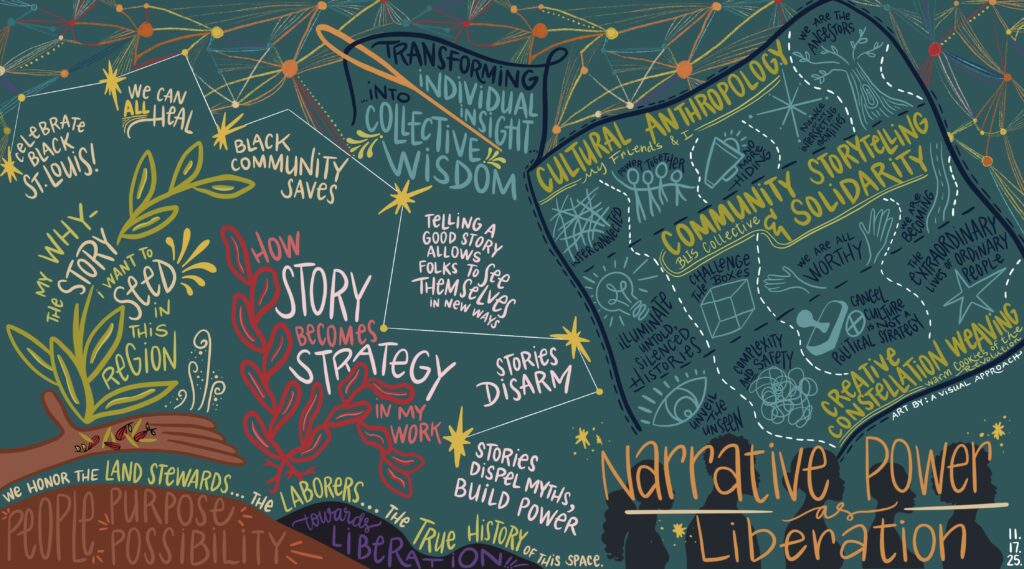
Our aim is to cultivate a narrative ecosystem that outlives any one messaging campaign. We are not naive enough to believe it can all be built in just nine months, but we have taken the first step.
We also shifted from six-week funding cycles to rapid response. When an F3 tornado struck without warning, we proved that speed is a form of impact by getting resources to community first responders in time to make a difference.
Additionally, we shifted from funding in isolation to selective investment in collaborative partnerships — such as the Midwest Catalytic Collaborative (MCC) — as these partnerships strengthen broader ecosystems.
Launched in 2025 and inspired by funder organizing models in the South, MCC offers a way to build in the Midwest the kind of regional infrastructure, strategic alignment and ecosystem investment that philanthropy on the East and West Coasts have long benefited from.
MCC pools resources through its Catalyze Fund to provide flexible, multi-year support to grassroots organizing that is often underestimated by philanthropy but essential to building long-term community power. The fund has awarded $1 million in grants across eight states — Illinois, Indiana, Iowa, Michigan, Minnesota, Missouri, Ohio and Wisconsin to organizations on the frontlines. Each state is supported by a dedicated advisor embedded in the local organizing ecosystem. This helps ensure funding decisions are shaped by relationships, lived experience and on-the-ground knowledge rather than distance and assumption.
If the Midwest is truly consequential to the future of our democracy, as many believe, it deserves the same level of coordinated investment in organizing infrastructure, leadership and long-term power-building. Under the leadership of Jay Travis, executive director of Needmor Fund for Social Justice, MCC is built on a transformative premise: durable victories require durable ecosystems.
What distinguishes MCC is that it does not begin with organizations. It centers ecosystems. Through shared analysis, aligned investment and deep regional collaboration, MCC demonstrates what it means to think like a sector, fund like a sector and show up like a sector. It recognizes that communities win when relationships, leadership and organizing capacity are cultivated over decades, not election cycles.
To date, the biggest accomplishment has been moving away from fragmentation toward alignment. Our focus is not just institutional self-preservation but shared responsibility. Rather than asking what Deaconess could accomplish alone, we are focused on what becomes possible when invisibilized communities, movements, partners, unlikely allies and philanthropic institutions move in greater coherence.
Institutions may hold assets, but relationships are the infrastructure that makes true transformation possible. Therefore, thinking like a sector and funding to win requires a commitment to get in and stay in relationship with one another, to learn and unlearn together, and to see ourselves as co-creators of a world where future generations inherit stronger conditions for sustaining and protecting wellbeing and wholeness.
I still find myself pondering the challenge Ash-Lee Woodard Henderson and Lisa Owens surfaced: What would it look like to think, fund and move like a sector? Coherence does not require institutions to become identical. It asks us to stay in relationship deeply enough to align our values, resources, learning and influence so we can respond with the collective agility this moment demands. Isn’t that the future we are inspired to build?
Bethany Johnson-Javois is a health and racial justice advocate dedicated to the improved health and well-being of the people of the Greater St. Louis region and Southern Illinois. She is President & CEO of Deaconess Foundation and Pastor of Monument of Faith Church, Inc..