
Most of us have encountered Maslow’s hierarchy somewhere between a high school classroom and a corporate leadership workshop. The pyramid is tidy, intuitive and almost comforting in its logic: meet basic needs first, and the path to human flourishing opens. Food. Safety. Belonging. Esteem. And at the top, glittering like a destination: self-actualization. The fullest expression of human potential.
But what happens when the structure surrounding an individual is itself the obstacle?
As a Community & Grants Specialist working with partner organizations across sub-Saharan Africa, I have watched what changes when a community is trusted with resources and decisions rather than managed through them. I have also seen the limits of even the most well-resourced, well-intentioned programs when the systems surrounding them remain unchanged.
I have watched what changes when a community is trusted with resources and decisions rather than managed through them.
For decades, programs responding to poverty, inequality and underdevelopment have focused on skills training. Scholarships. Mentorship. Leadership academies. Youth development. Entrepreneurship. Many are well-designed, well-intentioned and genuinely life-changing for the individuals who pass through them.
And yet, the communities those individuals come from remain largely unchanged. An individual may climb, but the community remains.
This is the escape hatch problem: a program invests in an exceptional individual who, upon gaining capability, migrates away from the community that produced them to participate in systems built elsewhere. The program succeeded for the individual, but did it reach the community it was designed to serve? Philanthropy, too often, counts it as a win. Isolated programs, however excellent, produce isolated outcomes.
Through my work with partners in South Africa, I have seen this pattern on the Cape Flats — an expansive peri-urban area on the outskirts of Cape Town, built under apartheid to house Black and Coloured communities forcibly removed from the city center and still carrying the full weight of that deliberate disinvestment today. These areas have received sustained attention from development programming for decades through skills programs, youth interventions, leadership initiatives. The individuals who move through those programs often go on to forge new lives elsewhere, far removed from the communities where the investment was made. What moves far more slowly are the structural conditions — the safety, economic opportunity and collective agency — that would have made staying not just possible but desirable. The programs address a crisis, not the conditions that produced it.
An exception is not equity. An exception is not transformation. A sector that celebrates exceptions while the rule remains unchanged has confused activity with impact.
A sector that celebrates exceptions while the rule remains unchanged has confused activity with impact.
The escape hatch does not only operate across geography; it also operates across gender. This is especially visible in communities where investment in one group — however justified, however necessary — has proceeded without attending to the conditions that group returns to every day.
Gender equity programming has rightly centered girls and women, who have been systematically excluded and harmed by patriarchal structures. But in many cases, it has been programmatic rather than systemic. It targeted a group without transforming the conditions around them. And those conditions include boys who are also shaped by norms nobody has invested in transforming. Patriarchy did not only limit women — it also failed to equip men with the tools to respond differently. Both were expected to return to the same environment and produce different outcomes.
This is the escape hatch problem wearing a gendered lens. And it is the same logic that plays out across race, class and other contexts where we invest in a person rather than the ecosystem that person inhabits. Ubuntu understood this long before the sector did: You cannot uplift one part of a community while leaving the rest untouched and expect the community to move.
Ubuntu Reframes Everything
Maslow’s pyramid was fundamentally built around an individual climbing alone. The community, in his framing, is context. Background. Not the protagonist.
In the African context, Ubuntu offers a different starting point entirely. It does not begin with the isolated individual and ask how they relate to others; it begins with the relationship itself as the primary unit of human existence. You do not become fully human alone. Your humanity is constituted, expressed and sustained through your connection to others — to family, community, those who came before and those who will come after.
If a person is a person through other persons, then the flourishing of an individual is inseparable from the flourishing of their community. The young person who reaches self-actualization does not do so despite their community — they do so through it. A development model that invests in individuals, celebrates their achievements and considers the work done has left the community behind.
There is also something Maslow leaves implicit: the path to self-actualization requires knowledge. Not just access to resources, but understanding of how to navigate systems, claim rights and make decisions about health, safety and civic life. This gap is not one of intelligence or capacity. It is one of investment.
Working at the intersection of health, gender and community development, I have watched this play out. Young women who access sexual and reproductive health information not only gain knowledge but also gain a different relationship to their own bodies, decisions and futures. But that shift does not happen in isolation. When the knowledge infrastructure ends at the program boundary, so does the change.
Communities want more than to be served — they want ownership. Participatory development research — an approach that prioritizes the active involvement of communities in identifying their own needs, designing responses and leading implementation — has long reinforced this. Community ownership is not a feel-good add-on; it is a mechanism by which individual change becomes collective change and how you close the gap between the exception and the rule.
Communities want more than to be served — they want ownership.
On a 2022 site visit to Bulungula, a remote village in South Africa’s Eastern Cape, I saw what community-led investment looks like. The community co-owned a village lodge built on its land from the start and has since gained full ownership. That ownership helped lay the groundwork for a community-built clinic, and funders followed the community’s lead by providing resources for staff. A youth-run radio station kept the village engaged in its own vision. The community has been able to continuously identify its needs and respond accordingly.
Investing in Capability
In 1999, Amartya Sen published Development as Freedom, reframing the question from “How do we grow economies and reduce poverty?” to “What are people actually able to do and be?”
A community can receive significant investment and remain structurally unable to determine its own future.
A community can receive significant investment and remain structurally unable to determine its own future. The transfer happened. The capability did not follow.
This is the reframe the philanthropic sector most urgently needs. Charity asks, “What does this person lack, and how do we provide it?” Infrastructure asks, “What conditions need to exist for people to meet their own needs, exercise their own agency and build their own futures?” Charity leaves underlying conditions unchanged, which is why the same communities appear in the same funding proposals, cycle after cycle. Infrastructure, when it works, builds something that persists.
When a young person develops their capabilities — their health literacy, economic agency, civic knowledge and sense of self — they become a node of capacity in a network of relationships. They parent differently. They model possibility for others. They contribute to a collective raising of the floor.
For grantmakers, a capabilities-centered approach means funding longer, trusting more and measuring differently. It means funding community-led organizations over extended time horizons because building collective capability is not a 12-month project. It means shifting power, not just money, and measuring not just outputs but conditions — not just how many young people attended a workshop but whether the community’s capacity to advocate for its own people has actually grown.
For grantmakers, a capabilities-centered approach means funding longer, trusting more and measuring differently.
None of this is an argument against individual programs. The young person who gains a skill, completes an education and finds language for their experience — that matters. The argument is that individual programs, unsupported by systems investment, will hit a ceiling. And a sector that funds individual programs without asking about the conditions surrounding them is not yet asking the full question.
The Point Was Never the Pyramid
Human flourishing is measured in access to safety, health, knowledge, dignity and the conditions in which our full humanity can be expressed. Not in who made it out, but in whether the community itself is rising.
The goal is not to produce a generation of individuals capable of escaping their circumstances. It is to build communities where escape is no longer necessary.
So what does this ask of grantmakers, concretely?
- Extend your funding cycles. Fund at least three to five years for community-based organizations doing systems work. A 12-month grant cycle does not reflect the time systems change takes.
- Stop measuring what is easy to count. Certificates issued and workshops attended tell you that something happened. They do not tell you whether anything changed. Measure conditions like safety, agency and collective capacity even when those things are harder to put on a graph.
- Trust communities with unrestricted resources. Unrestricted funding gives community-based organizations greater flexibility to respond to what they know about their communities and adapt as conditions change. Accountability matters, but reporting requirements can extract more energy from organizations than they return in value.
And ask yourself honestly whether your funding is building communities with the capacity to shape their own futures or primarily producing exceptional individuals who leave while the conditions around them remain unchanged. If it is the latter, you may be funding the escape hatch. And the escape hatch is not a strategy.
The point was never the pyramid. The point was always the people. All of them. Together. That is what Ubuntu has always known. It is past time for our systems to catch up.
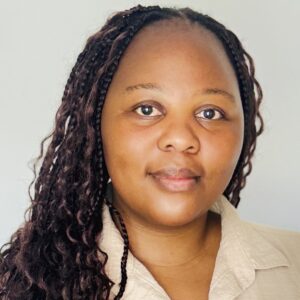
Busiswa Dayimani is a Community & Grants Specialist at the Charlize Theron Africa Outreach Project (CTAOP), working at the intersection of sexual and reproductive health and rights, gender-based violence, and grassroots development. With 13 years’ experience in youth development and philanthropy, she is committed to community-led change across South Africa and sub-Saharan Africa.