
Insights from 25 years of Youth-Centered Practices at Hopelab
Since Hopelab’s founding nearly 25 years ago, our journey toward youth-centered philanthropy has required us to consistently reflect on and adapt our participatory practices and organizational structures. What began in our earliest years as an operating foundation harnessing youth co-creation in program design evolved into a fundamental reimagining and ongoing practice of how we can share decision-making power with young leaders.
As a philanthropic organization that is focused on the mental health and well-being of Black, Brown, and Queer young people, one of our core organizational beliefs and values is that achieving more equitable outcomes for young people requires intergenerational partnership and a shift in who holds power. During this two-and-a-half-decade journey of exploring youth co-creation, youth power, and intergenerational partnerships, we’ve continued to evolve our practices and approaches, many of which are aligned with GEO’s recent publication and programming on community-centered philanthropy. Here are some of our reflections on ways those practices have helped us to authentically partner with young people.
Intentionally Shifting the Spectrum of Participation
Building a community of young change-makers has involved fundamentally shifting who holds decision-making power and authority within our organization. For us, this often looked like a number of seemingly small steps to create pathways for youth leadership and decision-making. Specifically, in the mental health context in which our organization operates, Black, Brown, and Queer young people bring lived expertise that challenges deficit-based narratives and surfaces solutions that address root causes rather than symptoms.
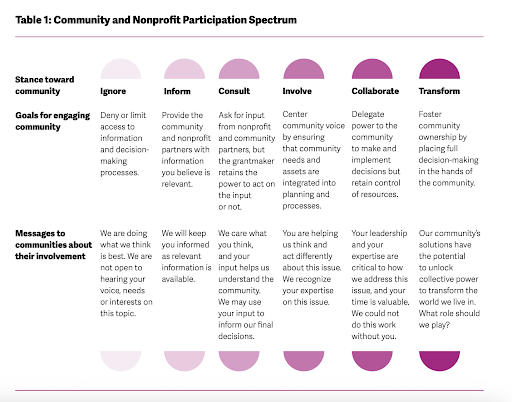
While traditional youth advisory boards have played an important role in our ability to co-create with young people, they often revolved around the “inform, consult, involve” section of the spectrum [See Table 1 above]. As our own organizational conversations and readiness grew, we aligned internally on a shared intention to grant young people actual decision-making power. This includes strategy and financial responsibilities typically handled by an organization’s leadership – such as young people sharing decision-making power with funders on the steering committee of a collaborative fund, or building an intergenerational Board of Directors at Hopelab. This commitment requires that we invite young people to the table in ways different from how we have historically and remain willing to reimagine and redesign the table entirely.
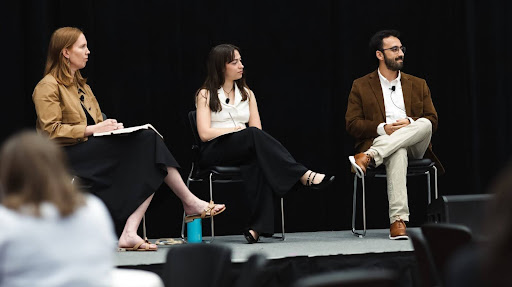
“I believe young people are the epicenter of power, and Hopelab shares that vision. I’m committed to bringing that perspective to the board and our work together. Hopelab is leaning into its mission to protect young Queer people during such an essential time.” – Arielle Geismar, Hopelab’s Board of Directors
Shared Power Through Funding Decisions
Like many traditional philanthropic organizations, our funding decisions were rarely driven by young people themselves. We found ourselves eager to experiment with power-sharing in grantmaking via our role in a collaborative fund. The Responsible Technology Youth Power Fund (RTYPF) is in its third year of funding youth- and intergenerationally-led organizations and young leaders who are collectively defining what responsible technology looks like for their communities while building solutions that shape a more equitable ecosystem.
In its second year, the RTYPF steering committee, which at the time consisted of five funders, added five additional seats to include young leaders from the inaugural grantee cohort. Each young leader received $75,000, providing them with the financial resources to remain focused on their organizational goals while actively participating in grant selection, ecosystem building, and direction setting for the Fund. This small step helped refine our grantmaking goals to focus on three specific areas of responsible technology: AI, climate activism, and mental health. By reimagining power structures, even in small ways, Hopelab and our co-funders saw what was possible when young people moved across the participation spectrum to collaborate and transform the RTYPF’s grantmaking potential. Now in its third year, the Fund has mobilized $7.5 million of support for diverse young leaders, with modest investments from 17 co-funders and an intergenerational grantmaking approach.
The Responsible Technology Youth Power Fund illustrates the possibilities and the complexities of collaborative funding and power-sharing. The real learning continues as we navigate questions like: How do organizations balance accountability to our boards with genuine trust in young leaders? When young steering committee members propose priorities that differ from those of funders, how do we honor their expertise and fulfill institutional obligations? We’ve found that continued co-creation through these tensions is what keeps productivity flowing. Getting comfortable with the uncomfortable, so to speak.
“From intergenerational collaboration to meaningful youth engagement, the best way to give young people a real seat at the table is to give them the opportunity to create the digital world in which they want to live.” – Trisha Prabhu, Creator and Founder of ReThink, RTYPF Grantee, and former steering committee member
Research Partners Reimagined
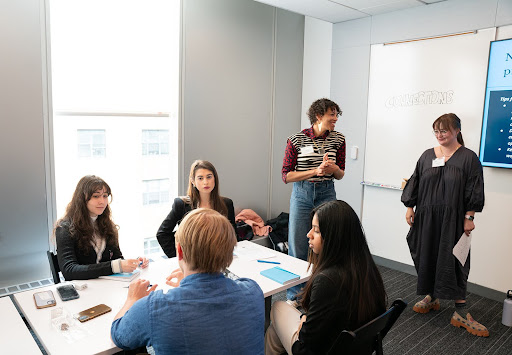
Partnerships with young people also yielded powerful changes in how we conduct research. For the past few years, Hopelab has overseen a National Survey on social media’s role in youth mental health. The first two iterations of the survey, starting in 2018, were conducted quite traditionally, with minimal input, interpretation, or consultation with young people. The third installment of the National Survey, conducted in 2024, deliberately sought to co-create the process with young people. To accomplish this, Hopelab’s research team collaborated with young people (via a partnership with In Tandem), who provided direction and input on survey content and the interpretation of results through focus groups and individual interviews. Our priority was to conduct a youth engagement effort that informed our research and provided a meaningful experience for the young people involved.
The experience was not always smooth sailing, and our initial assumptions about engagement were challenged repeatedly. We learned that traditional research timelines were incompatible with the academic calendars and other commitments of young people. We shared key learnings from the experience in a case study co-created with the Center for Digital Thriving: “Demystifying Youth-Engaged Research.” When there is a genuine desire to include young people in strategy, funding, or decision-making, taking the first step is often the hardest part. With the right support systems and models for replicating effective processes, we hope others will recognize the value of working with young people enough to make it a reality.
We shared an example of co-creation and the giving of narrative power to young people in chapter nine of the Youth Voice Playbook. When disseminating the results of Hopelab’s National Survey, our strategic communications team reached out to young people who were not directly involved in the research to give real-life examples of the findings. Gael Aitor, the creator and host of the “Teenage Therapy” podcast, blogged about how social media provides young people with access to informal mental health support and community connection, specifically in ‘third-spaces’ outside of the mental health care system. He shares, “Storytelling and community building through unconventional means are fundamental components of how modern teens address their mental health needs… While not traditional therapy, my group of friends and I spent four years recording episodes documenting the raw and vulnerable conversations we had during our coming-of-age. Episodes titled “Listen when you feel alone” still garner over 300k streams years after their release, proving a strong demand for comforting mental health content — an alternative, supportive tool different from traditional online therapy.”

Early Evidence, Ongoing Learning
While we’re seeing encouraging outcomes from these collaborative efforts, including stronger connections for grantees and a more nuanced understanding of youth mental health, we are still developing frameworks to better understand the impact of power-sharing for both young leaders and the philanthropic sector. Traditional grantmaking metrics aren’t necessarily designed to capture shifts in power or quality of experience. We continue to evolve our evaluation approaches and redefine what “success” means, recognizing that shifts in mindsets, relationships, and where power sits are critically important.
We share these reflections knowing that while they represent Hopelab’s journey, there are many peers and co-conspirators on the path with us. We’re eager to learn from peers navigating similar contexts, particularly if there are structures that help other funders authentically share power with young people. As we continue this work in our own organization, as well as contribute towards shifting our sector, we are committed to sharing our learnings and collaborating with this community as we work toward a future where young people have equitable opportunities to live joyful and purposeful lives.

Tracey Kirui is the Chief of Staff and Strategic Partnerships at Hopelab, where she partners with the CEO to translate priorities into coordinated action and cultivates partnerships that advance Hopelab’s mission.

Joshua Lavra co-leads Hopelab’s Futures portfolio, sensing and exploring emerging trends, impact possibilities, and partnership opportunities that may shape the far future of youth mental health and well-being.

Arianna Taboada is the Director of Learning and Impact at Hopelab, where she helps the organization build learning and evaluation practices that inform strategic decision-making.