Many philanthropic leaders draw strength from the perpetuity of their institutions. Their endowment management policies create long time horizons that, in turn, yield expansive possibilities.
What would happen if grantmakers understood that our grantees — whose courage and action we mean to foster — could achieve so much more with the same consistency, stability and financial freedom?
What about the time and energy taken from work on the ground as grantees try to meet the ever-changing and more complicated demands of funders?
Imagine what the communities you support with funding could do if they had that same sense of security and stability.
Think about the worries you as a grantmaker don’t have if your institution has an endowment. Now, imagine what the communities you support with funding could do if they had that same sense of security and stability. They could plan. They could take risks. They could build infrastructure and pursue a mission over generations.
Moving Away From Outdated Practices
Philanthropy’s default modus operandi of short-term grants and heavy reporting requirements leaves nonprofits and communities wondering where they’ll be in a year. We favor short-term outcomes over long-term focus, support and room to maneuver. We keep nonprofit leaders accountable to philanthropy professionals through reports and metrics, leaving them less accountable to their own communities and creating perverse incentives that weaken the work funders claim to champion. Our decision-making process centers institutional needs and limits our communities’ security and freedom to act.
I believe that grantees can activate transformative change in their communities if — and only if — funders get out of their way and let them make it happen.
First, let’s empower grantees by overhauling our piecemeal approach in favor of multiyear, general operating grants. Power-building and other community-based organizations have been advocating for this for years, but loosening the reins flies in the face of our usual routine of accountability metrics, compliance and a fixed grant administration process.
By shifting to multiyear grants, funders give leaders back the time and talent we make them spend on grant writing and reporting.
By shifting to multiyear grants, funders give leaders back the time and talent we make them spend on grant writing and reporting. Focusing dollars on general operations instead of specific programs places trust in these leaders to shape their own programs. Organizations get the latitude they need to both experiment and endure, which can lead to long-term change and implementation of their wins.
Many funders are already moving in this direction. The Satterberg Foundation was an early adopter of flexible funding and has moved toward multiyear, unrestricted grants as a core practice, particularly for organizations advancing racial equity and systems change. The Heising-Simons Foundation adopted a similar, flexible practice in order to sustain movement infrastructure and policy advocacy organizations. The California Endowment, California Wellness Foundation and the Weingart Foundation have all moved toward this model as well.
The work requires no less. The most enduring results that the Liberty Hill Foundation has fostered fall under our Agenda for a Just Future campaign, which has nurtured sectors and long-term goals. Over its lifetime, whole ecosystems of community-based organizations have emerged to reduce the number of youth in local jails, phase out neighborhood oil drilling and develop the political power to pass Measure ULA. This measure created a permanent affordable housing and homelessness prevention fund in the city of Los Angeles that has already passed the billion-dollar mark, supported representation for thousands of people facing evictions, and funded hundreds of units of affordable housing with thousands to come.
Multiyear Funding for Trust
We don’t have to fear that moving toward multiyear funding will compromise accountability. Liberty Hill’s Liberation Fund, developed to put an end to the incarceration of girls and gender-expansive youth, began with a funded year of wide-open program planning to be led by the same cohort of grantees that would execute that program. As the second year neared, the grantees told our program officer that they wanted to be accountable to specific metrics and goals — but ones they developed, not handed down from us.
Trusting our partners can foster reciprocal trust, leading to an authentic relationship.
Trusting our partners can foster reciprocal trust, leading to an authentic relationship. Trust allows us to deploy resources quickly and effectively in crisis. We’ve seen the results of this in emergency situations such as COVID in 2020, when freeing up grantees to strike their own balances between direct services and organizing for change prepared them to reach highly vulnerable people and direct public systems toward the most efficient forms of assistance. In 2025, funders responded to wildfires and immigration raids by deploying resources through worker centers that they had funded for years, helping immigrant workers whose livelihoods were shaken by the fires and whose safety was then under direct threat from the federal government.
These changes open doors. Starting from trust can foster connections with young organizations breaking new ground and break our reliance on established groups that reflect our own professional priorities back to us. Liberty Hill has had success with programs to both nurture emerging leaders and to help organizations build and maintain capacity over the long term. Pairing this support with multiyear, general operating grants fosters strong and resilient organizations in issue areas and geographies that need them the most.
Commitment to Build Democracy
Funding social change is a commitment to building democracy, and today, democracy faces unprecedented threats. We must ask whether our habits and business models unleash democratic power or thwart it. If the latter, we must reorient ourselves to supporting communities and the organizations that serve them.
We must ask whether our habits and business models unleash democratic power or thwart it.
This may push us up against one of the profound, structural paradoxes of our work: the wealth behind every grant we fund is born from the very injustices it seeks to uproot. In the words of Mahatma Gandhi: “The means may be likened to a seed, the end to a tree; and there is just the same inviolable connection between the means and the end as there is between the seed and the tree.” Is it any surprise that philanthropic governance models would, whether intending to or not, limit democratic power?
Like all good paradoxes, this one cannot be solved. But it must be confronted, interrogated and constantly checked.
Resourcing communities to build their collective power to determine their own futures is not a program. It is the only chance we have of making our democracy fulfill its promise of justice and equality for all.
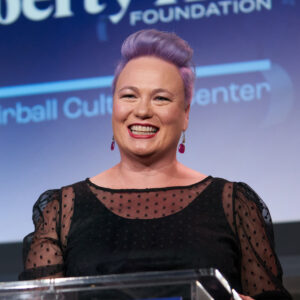
Shane Murphy Goldsmith is the president and CEO of the Liberty Hill Foundation, one of the nation’s most admired social change foundations and a leader in funding grassroots community organizing in Los Angeles. Since becoming CEO in 2013, Shane has led Liberty Hill’s transformation into a powerful force for systemic change, significantly expanding its capacity, influence and impact across the region.