For more than a year, foundations have been forced to grapple with significant shifts that continue to impact themselves and their grantee partners, including major declines in federal funding streams and data infrastructure, heightened levels of risk associated with equity-focused work, and more. Those changes have had ripple effects for people working in evaluation and learning. As consultants in this space, the differences we were seeing felt stark and rapid. Some of us saw our philanthropic learning work paused, never started, or ended prematurely. We were hearing stories of large–scale layoffs in firms and even of entire E&L departments in foundations. While we believe that these rapidly changing and chaotic times lend themselves to emergent approaches and rapid learning, we weren’t necessarily seeing this behavior in the field. But was what we were sensing and seeing indicative of broader trends and changes?
Let’s Keep Learning, a partnership between Engage R+D and ORS Impact, set out to collect data to learn more, so that E&L infrastructure and philanthropy could have better information to act on. In fall 2025, we fielded a pulse survey that reached nearly 200 philanthropic E&L practitioners — including foundation E&L staff, consulting firms, and independent consultants — asking about shifts they’d experienced over the past year and what they anticipated in the year ahead. In February 2026, we brought survey respondents together in virtual sensemaking sessions to interpret the findings.
Below, we share what we’re learning in hopes that we can collectively figure out how evaluation and learning best realizes its value proposition in these changing times: helping people understand their impact and learn so they are more likely to achieve the meaningful, equitable, sustainable ends their missions seek.
What The Data Showed: Three Key Takeaways
#1: The field is experiencing uneven change
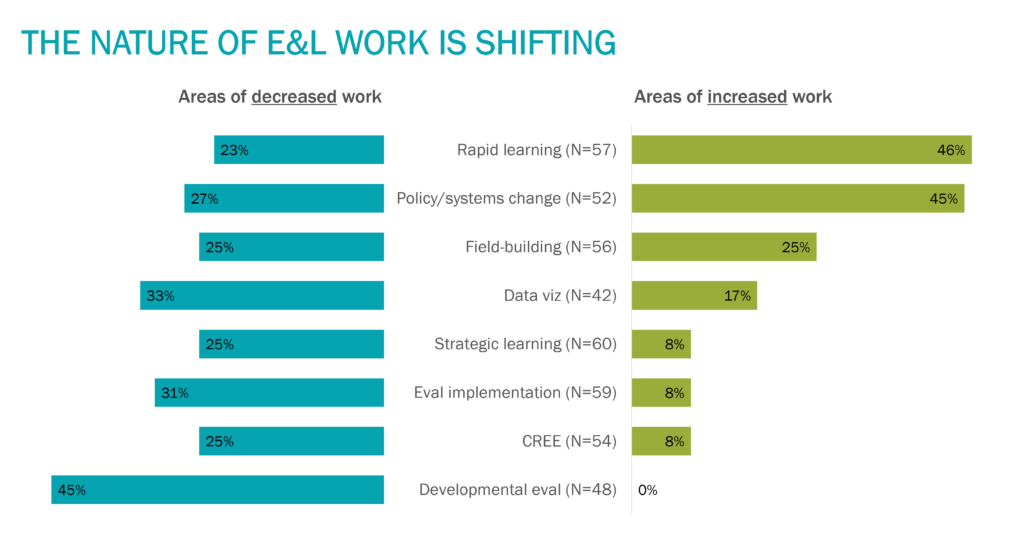
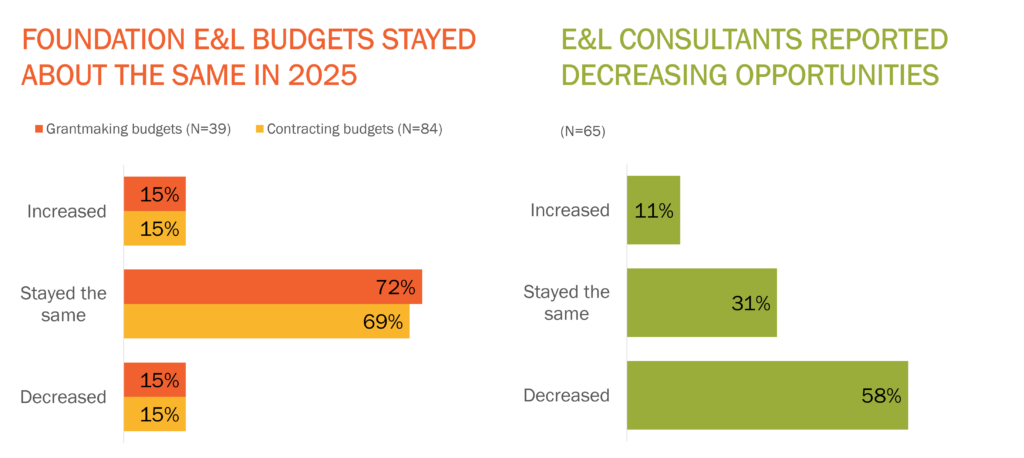
Two-thirds of foundation E&L staff reported that their staffing and budgets had stayed relatively stable, even as the environment around them shifted. Within this context, some foundation E&L staff took on a broader role, helping their organizations make sense of a rapidly changing landscape, supporting scenario planning, and informing strategic decision-making. Others described more mixed experiences, with responsibilities growing in some areas while quietly contracting in others. Equity-focused work, external sharing, and field-building were among the areas most likely to see reductions, reflecting in part political pressures and legal caution that many foundations are navigating right now.
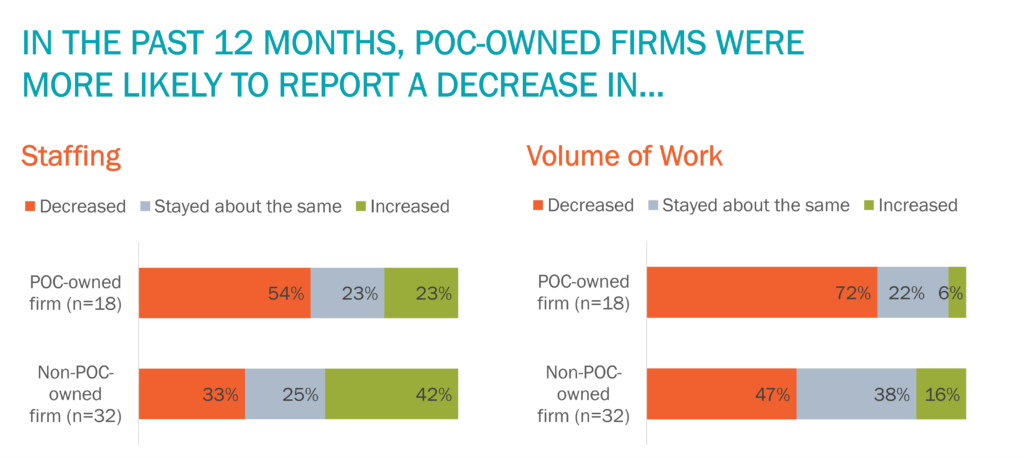
Consultants, however, were experiencing a meaningfully different reality. More than half reported a decrease in available philanthropic work, with an average 40% drop in the volume of project opportunities. Independent consultants and BIPOC-owned firms were especially affected, reporting lower demand and greater uncertainty at higher rates than their peers. And unlike funders, who expressed relative confidence about the year ahead, nearly three-quarters of independent consultants expected investment in E&L to continue to decrease over the next 12 months.
#2: Equity Progress Feels Particularly Fragile
Consultants and E&L staff expressed concern that recent advances—particularly investments in culturally responsive and equity-focused evaluation and pipeline expansion work—may be difficult to sustain amid financial pressure, political shifts, and increased demand for speed and simplified metrics. Data show that POC-led firms and independent consultants are disproportionately affected by market contraction, raising concerns about loss of diversity, experience, and perspective in the field.
#3: Concern about the Value Proposition
“The evaluation and learning function in a foundation has to generate clear and compelling value for leadership’s strategic decision-making.” – Funder
The value proposition for E&L is under renewed scrutiny. Across both funders and consultants, participants emphasized the need to more clearly articulate how E&L strengthens decision-making and organizational effectiveness. Some described increased pressure to deliver faster, simpler outputs, as well as assumptions that new technologies could reduce the need for dedicated E&L capacity. These dynamics are prompting both internal teams and external consultants to rethink how they position and deliver their work.
Making Sense Of The Moment: A Rough Patch, Reset, Real Damage Or Redefinition?
Given the data, we wanted to do more than describe the moment: we wanted to understand what it meant and how to move forward. In our sensemaking sessions, we explored four possible interpretations: (1) that the field is experiencing a rough patch, (2) a market reset is occurring, (3) real damage is happening that could have lasting effects, or (4) it’s a moment for field redefinition.
Some saw the field as experiencing a rough patch that is real but temporary. Some saw that a small number of large funders may have pulled back their E&L activities in response to the current environment in ways that have rippled disproportionately through the consulting market. Or that funds, while still there, are not being released at the same rate during this uncertain time. And an influx of evaluators displaced from federal and international positions has likely intensified competition for a pool of philanthropic work that hasn’t grown to meet them. Others raised harder questions about how the field arrived here, and whether it may be experiencing a reset after a period of growth beyond market needs.
Some worried about what gets lost in this rough patch or reset, representing real damage to the field. When work is scarce and the pressure is toward speed and simplified metrics, it can become harder to protect approaches that take more time or require more trust, including equity-focused and culturally responsive methods. BIPOC-owned firms and independent consultants are bearing a disproportionate share of the market contraction, raising real concerns about the depth of expertise the field will carry forward.
But the conversations mostly gravitated toward a sense that the field is in the midst of genuine redefinition, with the shift not just reflecting market conditions but what foundations are asking evaluation and learning to do. For example, there is growing demand for work that moves faster than traditional evaluation cycles, connects more directly to decisions, and demonstrates its value in terms that resonate with boards and executives.
What Comes Next
Our sessions with funders and evaluators were heartening: while we saw people experiencing grief and some fear with all the rapid changes, we also heard a community that wants to contribute to meaningful, equitable impact through philanthropy. Likely these interpretations are not mutually exclusive — the field may be experiencing all of these things at once, playing out unevenly across roles, organizations, and communities. What the conversations made clear is that people are genuinely grappling with these questions, and that the answers matter not just for the professionals who work in evaluation and learning, but for philanthropy’s capacity to understand its impact and improve what it does.
We are continuing to deepen this work through follow-up conversations with foundation leaders and philanthropy-supporting organizations. In the meantime, we invite you to join us at the GEO 2026 National Conference on June 2 from 9:30 – 11:20 AM ET for Learning in a Shifting Landscape: Where Are the Opportunities to Strengthen Our Value? In this session, we’ll share what we’re seeing across the field and engage participants in examining how these dynamics are showing up in their own contexts—before turning to where there is real opportunity to adapt and strengthen learning and evaluation in this moment.

Meghan Hunt is a Senior Consultant at Engage R+D, where she leads participatory evaluation and learning partnerships with foundations and community organizations.


Sarah Stachowiak is CEO and owner of ORS Impact and loves helping philanthropic and nonprofit clients think about how data, measurement and evaluation can help them learn, strengthen their work, and make meaningful change in the world.